


Decathlon-Brompton Alliance: Impact on Urban and Wholesale Footwear
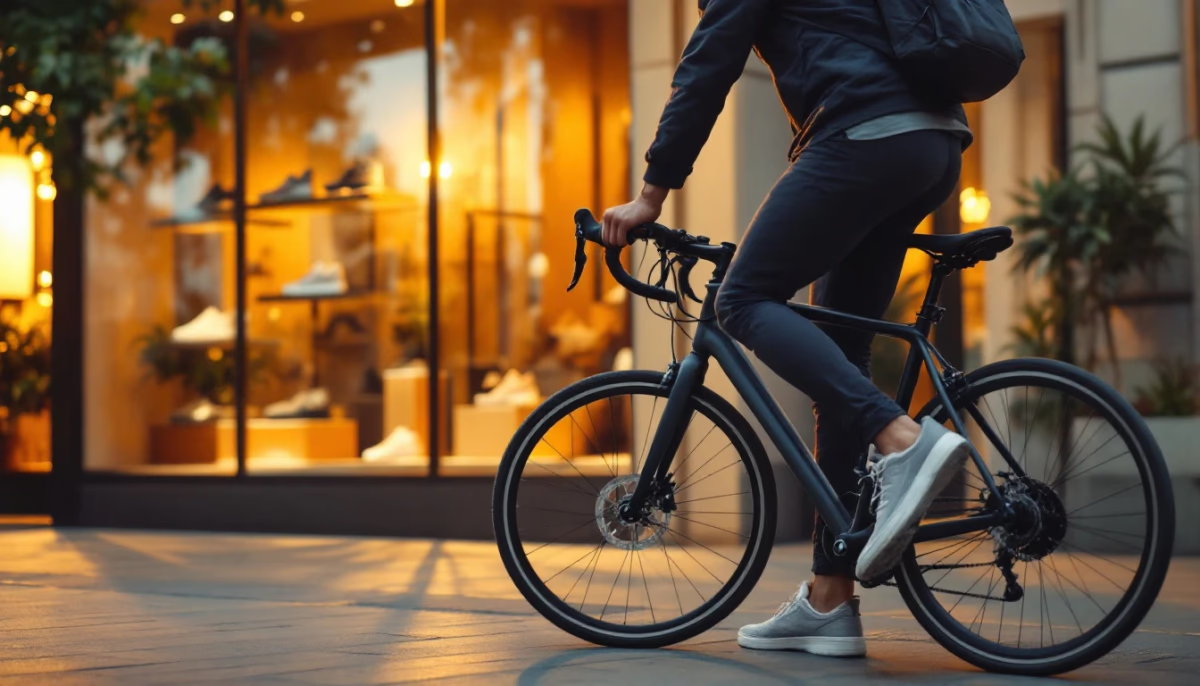
Table of contents
- Decathlon Pulse and Brompton: An Alliance Redefining Urban Mobility
- Implications for the Footwear Sector: What Does It Mean for Stores and Wholesalers?
- Context of the Spanish Market: Cities That Pedal
- Keys for the Footwear Store: How to Leverage the Trend
- Conclusion: An Alliance That Invites Rethinking Footwear
Decathlon Pulse and Brompton: An Alliance Redefining Urban Mobility
The recent strategic alliance between Decathlon Pulse, the investment and innovation arm of the sports giant, and Brompton, the iconic British folding bike brand, not only marks a milestone in the micromobility sector, but also sends clear signals about where urban consumption is headed. The agreement seeks to accelerate the adoption of the bicycle as a key solution for cities, preserving Brompton's independence and artisanal character, whose bikes have been hand-built in London since 1975 and have already surpassed 1.2 million units produced.
The global micromobility market, according to estimates shared by both companies, will grow from 175 billion euros to 360 billion euros by 2030. This exponential growth reflects a profound shift in commuting habits, especially in dense urban environments where intermodality, efficiency, and sustainability become priorities. Decathlon Pulse will act as a long-term strategic partner, supporting Brompton's expansion in key markets such as Germany and China, while maintaining its legacy of quality and local manufacturing.
Implications for the Footwear Sector: What Does It Mean for Stores and Wholesalers?
At first glance, a bicycle alliance may seem unrelated to the footwear business. However, any transformation in urban mobility has a direct impact on what people wear. When more people choose the bicycle as their daily means of transport, their footwear needs also change. Cycling commutes demand comfortable, functional, and often more durable shoes, especially if combined with walking or public transport. This opens a clear opportunity for footwear stores that want to position themselves in the urban-active segment.
For the footwear wholesaler, this trend translates into growing demand for product lines aimed at urban cyclists: footwear with slip-resistant soles, reinforcements in wear areas, designs that allow safe pedaling without sacrificing style. But there is also an indirect effect: the rise of micromobility reinforces the consumption of casual, sporty, and versatile footwear suitable for multimodal journeys. Traditional shoe stores that used to sell formal office footwear are starting to see how "athleisure" and technical-urban footwear gain ground, especially among young professionals who commute by bike.
Context of the Spanish Market: Cities That Pedal
Spain is no stranger to this phenomenon. Cities like Barcelona, Valencia, Seville, and Madrid have promoted bike lane networks and bike-sharing systems, fostering a cultural shift toward sustainable mobility. The Decathlon-Brompton alliance, although global, will have an echo in the Spanish market where Decathlon already has a massive presence and where Brompton has a loyal fan base. For the Spanish footwear wholesaler, this reinforces the need to adapt the assortment to a consumer who increasingly values functionality, durability, and environmental commitment.
Furthermore, the profile of premium folding bike buyers matches that of customers who invest in quality footwear, willing to pay more for well-designed and sustainable products. This opens the door to strategic collaborations between footwear brands and bike stores, or the creation of product packs that integrate footwear and mobility accessories. A wholesaler who anticipates this synergy will be able to offer their retail clients collections aligned with new commuting routines.
Keys for the Footwear Store: How to Leverage the Trend
- Expand urban offering: Include specific footwear for urban cycling and hybrid models suitable for both pedaling and walking.
- Communicate sustainable values: Consumers who choose bikes tend to prioritize responsible brands. Eco-friendly footwear with recycled materials or local production fits perfectly.
- Create cross-selling experiences: Partner with bike shops or workshops to offer cross-discounts or joint events that attract the cycling community.
- Train the team: Educate salespeople to recommend the right footwear based on the customer's type of commute.
"The growth of micromobility not only transforms cities, but also citizens' wardrobes. Functional urban footwear is already a booming category that no wholesaler can ignore."
For the wholesaler, the recommendation is clear: monitor local mobility trends, anticipate demand for specific cycling footwear, and seek suppliers offering differentiated products. Those who manage to connect their offering with the cyclist lifestyle will have a competitive advantage in an increasingly segmented retail market.
Conclusion: An Alliance That Invites Rethinking Footwear
The Decathlon-Brompton alliance is much more than a mobility news item: it is a thermometer of how urban consumption is evolving toward practicality, quality, and sustainability. For the footwear sector, especially on the wholesale side, it represents an opportunity to innovate in product and commercial strategy. Stores that know how to read these signals and adapt their assortment to the new multimodal citizen will be the ones leading the change.
Looking for a wholesale footwear supplier? Register at CalzadosJAM →
Comments
Leave a comment
Calzados JAM · Mayorista
Explora nuestro catálogo de +1000 referencias
Calzado al por mayor para mujer, hombre e infantil. Marcas nacionales e internacionales.
Newsletter
Newsletter
Get the latest news and exclusive offers in your inbox.

Be the first to comment