


3D holograms at the point of sale: the footwear retail revolution?
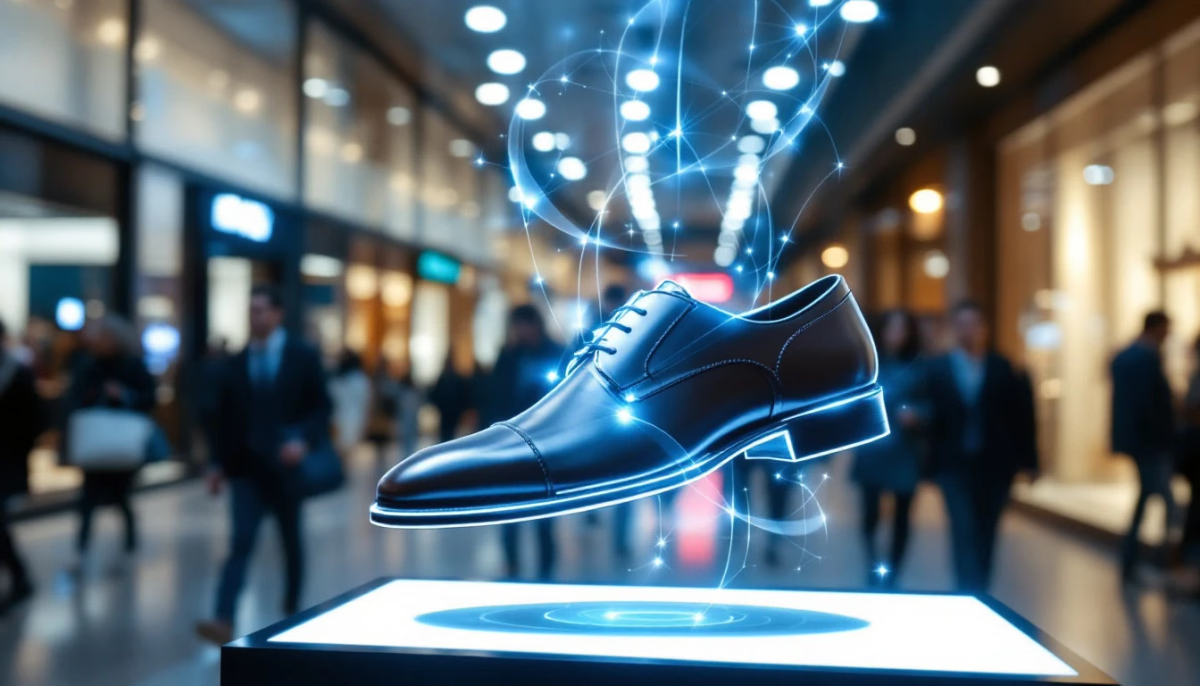
Table of contents
An immersive experience that goes beyond the screen
Henkel has launched a pioneering campaign in Spain with its got2b and Somat brands, installing three-dimensional holographic projections in shopping centers in Madrid and Barcelona. The technology, called HyperGram Experience, makes it possible to display products in 360 degrees floating in space, without the need for glasses or additional devices. The activation took place at intu Xanadú and Diagonal Mar, and combined the visual experience with exclusive discounts during the Exclusive Henkel Activations Days.
This move shows that major consumer brands are increasingly looking to move beyond the shelf and offer sensory experiences that capture consumers' attention in an environment saturated with stimuli. Although the initiative was temporary, it opens the door to reflecting on how physical retail can integrate immersive technologies to stand out from e-commerce.
Implications for footwear retail: more than a shop window
For a footwear store, adopting 3D holograms could mark a before and after in the way the product is presented. Imagine a shop window where shoes slowly rotate in the air, showing every stitch, the texture of the leather or the shine of the heel. This not only attracts attention, but also allows customers to examine the product in detail without having to handle it, reducing wear and tear on the displayed footwear and the need to constantly restock the sample display.
In addition, the technology can be used inside the store to offer interactive catalogs: the customer selects a model on a touch screen and a hologram projects it in 3D in front of them, allowing them to rotate it, view it from every angle and even combine it with different colors. This is especially useful for stores with limited space, where the entire collection cannot be exhibited. It can also be used in the fitting room area to show how the shoe would look in motion, simulating a virtual catwalk, improving the fitting experience and reducing returns caused by unmet expectations.
For a footwear wholesaler, this technology represents a high-impact B2B sales tool. Instead of carrying suitcases full of physical samples to trade fairs or sales presentations, a portable holographic system could be deployed to show the entire collection in 3D. The buyer could see the footwear with extreme realism, change the color or material in real time, and even see how the shoe looks on a virtual foot. This would reduce logistics costs, sample production and travel time, while generating an impression of innovation and modernity that reinforces the wholesaler's brand image.
Spanish market context: is footwear ready for the hologram?
Spain is a market where the physical store remains the main channel for purchasing footwear, with a strong tradition of neighborhood commerce and shopping centers. However, digitalization of the point of sale is advancing slowly. While large chains such as Zara or Decathlon have already integrated virtual fitting rooms or interactive screens, small and medium-sized footwear retailers still largely rely on personal attention and the traditional shop window.
The adoption of 3D holograms could be a key differentiator for independent stores seeking to compete with large retailers and online commerce. Initiatives such as Henkel's show that the technology is already available and that Spanish consumers respond positively to these experiences. However, the implementation cost (structural and maintenance) remains a barrier. More affordable solutions, such as small holographic projectors or rotating displays with augmented reality, could be the first step.
Moreover, footwear is a product especially suited to the 3D format: its three-dimensional design, stitching details, material shine and silhouette are elements that are much better appreciated in a holographic projection than in a flat image. For high-end footwear brands or designer shoes, the hologram can tell the product's story in a more immersive way, raising the perception of value.
From the wholesaler's perspective, being able to offer retail customers innovative sales tools strengthens the business relationship and positions the supplier as a strategic partner, not just as a product provider. In a sector where competition for end consumer attention is fierce, any technological advantage can translate into more foot traffic and higher conversion rates.
Conclusion: the future of footwear retail lies in experience
Henkel's bet with got2b and Somat is a clear sign that the point of sale is evolving into an experiential space, where technology is not a decoration but a tool for building emotional connections with customers. For the wholesale and retail footwear sector, ignoring this trend could mean being left behind in a market that increasingly values sensory differentiation.
3D holograms are not a science-fiction fantasy; they are here and are already being tested in Spanish shopping centers. The question is not whether they will reach shoe stores, but when and how they will adapt to the needs and budgets of the channel. Pioneers who bet on this technology now will be able to capture the attention of consumers looking for something more than a pair of shoes: they are looking for a memorable shopping experience.
Looking for a wholesale footwear supplier? Sign up at CalzadosJAM →
Comments
Leave a comment
Calzados JAM · Mayorista
Explora nuestro catálogo de +1000 referencias
Calzado al por mayor para mujer, hombre e infantil. Marcas nacionales e internacionales.
Newsletter
Newsletter
Get the latest news and exclusive offers in your inbox.

Be the first to comment