


Mercado Libre triples its logistics in Chile: what does it mean for footwear?
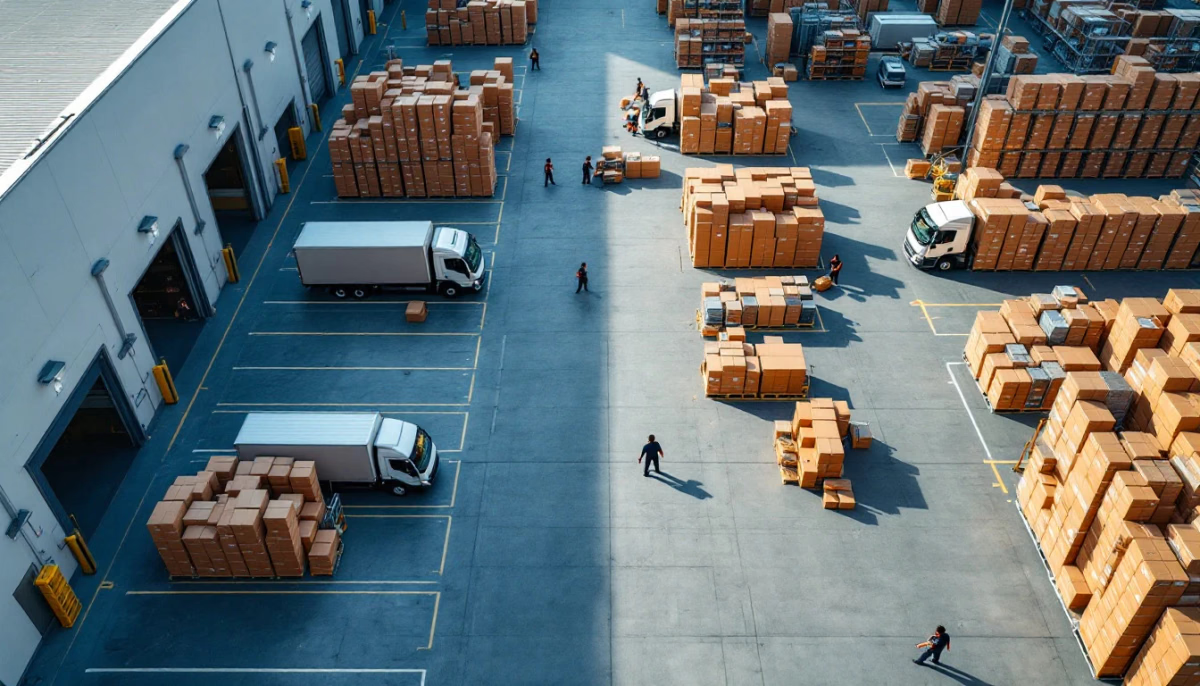
Table of contents
An unprecedented logistics bet in Chile
Mercado Libre, the Argentine e-commerce giant, has announced a $240 million investment to triple its logistics network in Chile. The company, based in Buenos Aires, will open two new distribution centers with a parallel investment of $120 million, which will multiply its storage and order processing capacity in the country by three. This move not only responds to the growth of e-commerce in the region but also marks a before and after in the logistics infrastructure of the Chilean market.
The creation of 2,500 direct jobs is another immediate impact, but what is most relevant for the footwear sector is the delivery capacity that will be enabled. With these new facilities, Mercado Libre will be able to reduce shipping times, expand geographic coverage, and offer a more agile shopping experience, which pressures other retail and wholesale players to raise the bar.
What does this mean for a footwear store?
For a footwear store that sells through marketplaces or has its own online store, the news has several readings. First, Mercado Libre's logistics improvement implies that Chilean consumers will expect faster and more reliable deliveries. If your store cannot compete on delivery times, you will lose sales to sellers using this infrastructure.
Second, the increase in logistics capacity can translate into a greater supply of products on the platform, intensifying competition. To stand out, footwear stores must differentiate themselves not only by price but by customer service, product curation, and brand experience. Logistics is no longer a differentiator but a basic requirement.
Furthermore, if your store depends on imports or wholesale suppliers, the improvement in the distribution network can lower indirect costs. But it also means that large e-commerce players will be able to offer international footwear brands more efficiently, forcing local stores to strengthen their value proposition.
Impact for the footwear wholesaler
For footwear wholesalers, the news is a wake-up call. Mercado Libre not only competes in retail but has also become a key channel for wholesalers to reach smaller stores. With a tripled logistics network, the platform can offer wholesalers a comprehensive storage and distribution solution, reducing the need to invest in their own infrastructure.
This can be an opportunity for wholesalers who want to expand without assuming large fixed costs. However, it also increases dependence on a third party for critical operations. Diversifying channels and investing in their own logistics or local alternatives will remain relevant to avoid being trapped on a single platform.
On the other hand, wholesalers operating in Chile must observe how this investment affects delivery times in rural or less accessible areas. The network expansion could reach markets that were previously unprofitable, opening new sales opportunities for wholesale footwear.
Context of the Spanish market
This news, although focused on Chile, has parallels with the Spanish market. In Spain, footwear e-commerce has grown steadily, and logistics is one of the most critical bottlenecks. Platforms like Amazon or AliExpress have invested heavily in warehouses and deliveries, and Spanish footwear wholesalers, especially those from the Elche or Menorca cluster, are feeling the pressure to adapt to a demand that requires speed and flexibility.
Mercado Libre's investment in Chile is a reminder that logistics is a key factor for competitiveness in footwear e-commerce. Spanish wholesalers who want to export to Latin America can benefit from this infrastructure, but they must also be attentive to changes in consumer expectations in the region.
Logistics is no longer a differentiator but a basic requirement for any player who wants to compete in online footwear.
Conclusion and outlook
The tripling of Mercado Libre's logistics network in Chile is not an isolated piece of news. It reflects a global trend toward the concentration of e-commerce in large platforms with robust infrastructure. For the footwear sector, this implies that operational efficiency will be as important as product quality or design.
Stores and wholesalers that do not invest in their own logistics or do not take advantage of third-party solutions risk being left behind. The question is not whether footwear e-commerce will grow, but who will be prepared to meet that demand quickly and at a reasonable cost.
In this context, choosing a reliable wholesale footwear supplier with responsive capacity is more critical than ever. If you are looking for a partner that understands market dynamics and offers quality products with competitive delivery times, Calzados JAM is your best option.
Looking for a wholesale footwear supplier? Register at CalzadosJAM →
Comments
Leave a comment
Calzados JAM · Mayorista
Explora nuestro catálogo de +1000 referencias
Calzado al por mayor para mujer, hombre e infantil. Marcas nacionales e internacionales.
Newsletter
Newsletter
Get the latest news and exclusive offers in your inbox.

Be the first to comment